
If you’re like most business owners, tax season doesn’t end after the initial deadlines pass. Now that we’re in April, many are wrapping up filings, double-checking compliance, and addressing any loose ends from earlier deadlines like January 31, when payroll tax forms and 1099s were due. In this article, we’ll cover the basics of 1099s you need to know, helping you stay compliant and on top of your filings year-round.
What is a 1099?
A 1099 is an IRS tax document that shows payments made to independent contractors. Just like an employee receives Form W-2 to report their income made during the year, independent contractors (also known as self-employed individuals) receive 1099s from each business they work with during the year.
When are 1099s due?
1099s are due on January 31st of each year. If January 31st falls on a weekend, the due date is the next business day.
What form should I use to request 1099 information?
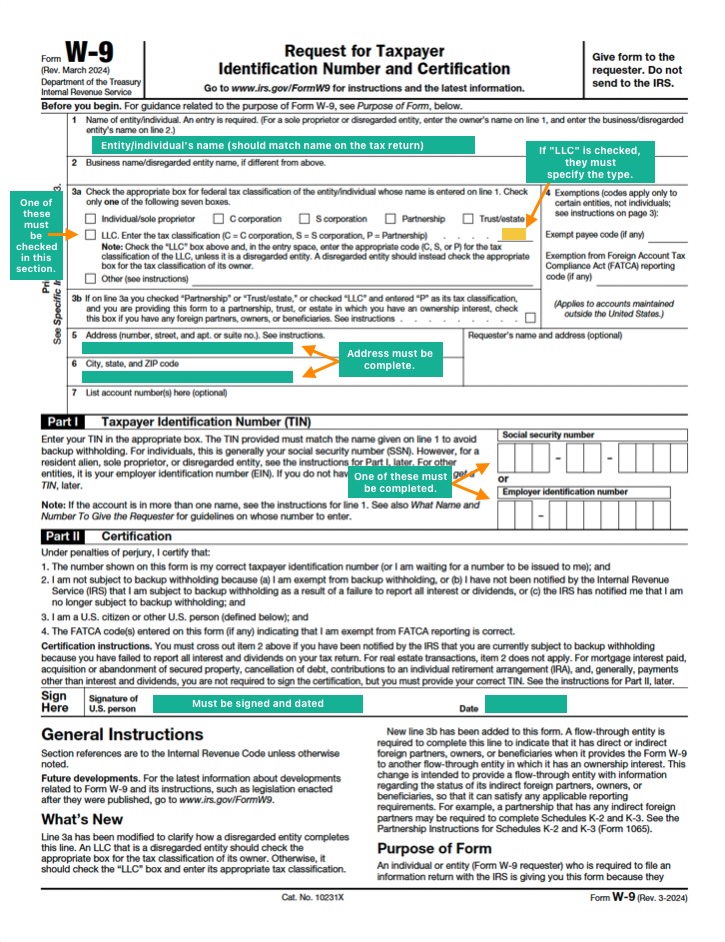
Before you pay a vendor, you should request a Form W-9. This form asks for key information for 1099 reporting, including the legal name of the individual or company, their tax identification number, and their business structure. With this information in hand, you can properly set up your accounting system to track 1099s. Here is an example of the minimum information required to be on a W-9 so that you can tell at a glance if it will be usable. Click to enlarge.
Who gets a 1099?
Form 1099-NEC is issued to each individual or unincorporated business (partnerships and LLCs) that you paid $2,000 or more to in 2026 (up from $600 in 2025) during the year for non-employee compensation. Eligible payments are for services, not products. For example, purchasing inventory from an individual would not qualify, but paying an individual to design a website would. Payments for rents and royalties are reported on Form 1099-MISC.
Are 1099s calculated on a cash or an accrual basis?
Since most independent contractors report on the cash basis of accounting when filing income and expenses on Schedule C, 1099s mimic this. This means that only the costs you paid during the year are applicable for the 1099. Accrued expenses for vendors won’t be included until they are actually paid.
What is the 1099 threshold?
Beginning in 2026, the 1099 threshold has increased to $2,000.
Do I have to send a 1099 to my landlord?
Yes, landlords that are individuals, LLCs (not S Corporations), or partnerships will receive Form 1099-MISC for rents paid during the year. If the landlord is a corporation, you do not need to issue a 1099.
Are extra expenses paid to landlords included in the 1099?
Yes, your 1099 will include all money paid to the landlord during the year, including utilities, repairs, and property-related invoices.
Do I have to send a 1099 to my attorney?
Yes, attorneys and law firms receive a 1099. Attorneys are one of the exceptions to the corporation rule. All attorneys and law firms receive a 1099 when payments exceed $2,000 in 2026, regardless of their business structure.
Do I have to send a 1099 to my CPA?
Yes, CPAs and accounting firms receive a 1099 when payments greater than $2,000 are made during the year. Unlike law firms, CPAs that are corporations are exempt from receiving a 1099.
I paid them through Venmo. Do I have to send them a 1099?
It depends on how the payment was sent through Venmo.
If you paid them using Venmo as a business transaction (goods and services), Venmo is considered a third-party payment processor. In that case, Venmo may issue a Form 1099-K to the recipient if they meet IRS reporting thresholds, and you generally do not need to issue a 1099-NEC.
However, if you sent the payment as a personal payment (friends and family), Venmo does not treat it as a business transaction. In that situation, the payment is treated the same as cash, check, or Zelle, and you are still responsible for issuing a 1099-NEC if the payment meets the IRS requirements (generally $2,000 or more for services).
It’s important to note that 1099 reporting is based on how the payment was processed, not whether the account is labeled “personal” or “business.”
What if I asked for a W-9 and they never gave me one?
A W-9 outlines the key details about the individual or business. Without a W-9, 1099 issuance is not possible. This is why getting a W-9 before payments are made is a best practice. This ensures you have no problems at year-end. If you have requested a W-9 and haven’t received it by the deadline, you may need to wait to issue a 1099.
Should I issue a 1099 to the owner I paid directly or the business?
1099s should be issued to the individual or business you pay. However, there is some leeway here. If you wrote a check to an individual, but did work with the business, you should verify who the 1099 should go to by requesting a W-9. Best practice is to issue a 1099 to who you pay.
What if I pay a contractor through QBO payroll, and I also write them a check that I didn’t tell QBO payroll about?
Businesses should only issue one 1099 to each vendor. If you write them a check that isn’t processed through QBO payroll, you will need to add the amount to your ledger. This is often done by coding the payment to the proper vendor. All payments made to a business or individual should be included in one gross 1099.
What if I don’t get you all the W-9s by January 31st? Do I have to file by then, or can I wait until I get them all and file after the 31st?
It’s not uncommon for W-9s to come in after the January 31st deadline. If you are waiting on one or two W-9s, you should not wait to file the other 1099s. File what you have and amend your filings to add additional ones as they come in. Let’s say you have ten 1099s to potentially issue. You have eight of the W-9s on file. The eight 1099s you have finalized should be filed by January 31st. Then, amend your filing to include the additional two, if you need to issue them. Failure to file your 1099s by the deadline can result in stiff fines and penalties from the IRS.
Summary
These are common 1099 questions that business owners come across during filing season. What other questions do you have? Contact me today to schedule your free consultation, even if it is past the deadline.